
|
Every tax is a pay cut. Every tax cut is a pay raise. Citizens for Limited Taxation |  |


|
|---|









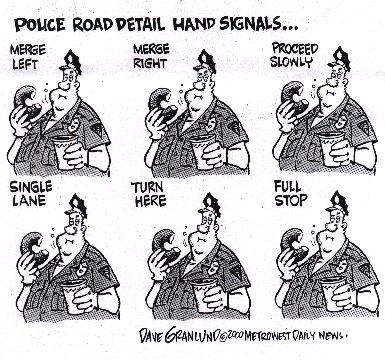
| Framingham police officer on construction detail before and after getting his degree using the Quinn bill. |
|---|
|
| Police officers can be considered
parasites on our society because
their unions change state statutes to benefit themselves.
Massachusetts is the only state in the union that provides it's police forces (unions) with a monopoly on detail work. Detail work runs at $43 per hour, unless it involves a labor dispute, in which case the rate is $86 per hour. This detail work allows them to shine as beacons of waste on our roadways each and every day. We are reminded everyday including Sundays of how the police waste $43/hour just standing around doing nothing. This type of work should pay closer to $12 an hour. It also makes them the highest paid employees in Framingham. The unions say that officers in detail are worth the cost because they can make arrests when a crime happens nearby. But if we want to pay officers to stand around and wait for a crime to happen, we should put them in high crime areas, not at work sites. The unions also contend that details don't burden taxpayers because it is mostly private construction and utility companies that have to pay. But construction and utility companies don't pay for details out of charity. They pass the costs on to consumers. The unions say that the officers need the money. But police officers are already the highest-paid public employees in their communities. Anyway, if they really need the money, we should put the cost of employing them in the city and state budgets where it belongs, rather than hide it in consumer and utility bills. A new and more stupid argument now is that any job of controlling traffic should be paid union wages or prevailing wages. The prevailing wage for flag men when not police officers is nearly $13.00. |
| Are Police IQs in Framingham Kept Low? |
|---|
| In a 10 year old case in New London, Connecticut, a candidate for
the city's police force was rejected for
being too intelligent
.
I have to ask myself if the Framingham police use this IQ filtering for it's own force? Given my encounters with the police, I suspect so. If we do so, in Framingham, what exactly is the purpose of the Quinn Bill? It costs us nearly $550,000 annually to educate the police. Framingham's annual report states that 60% of those applying get rejected although there is no criteria stated for rejection. The reason I bring this up is because they ride around in very well marked cruisers that state Framingham Police on both sides and have standard police lights on top, and yet, these officers actually park in handicap spaces as though they truly believe they are invisible to us. Our police chief talks about hiring only the best, but neglects to mention that the very best can only be drawn from those that apply. Of course, no one will ever admit hiring the worst. As a general rule, a Framingham police officer will have a double digit IQ and a triple digit salary, Police try to make us think that they have the best and brightest. The police actually believe that intellectually superior people routinely give up their careers in the medical field, dentistry, nuclear phyiscs, computer science, electrical egineering, structural engineer, physics, astronomy, cosmology, and genetic engineering in order to become police officers so that they can study how to break down doors, bust heads with a stick, threaten and harass people, and of course kill people in SWAT raids. Just observe a police officer doing detail work in Massachusetts and observe their keen intellect out in the open plains. |
|
September 9, 1999
METRO NEWS BRIEFS: CONNECTICUT; Judge Rules That Police Can Bar High I.Q. Scores A Federal judge has dismissed a lawsuit by a man who was barred from the New London police force because he scored too high on an intelligence test. In a ruling made public on Tuesday, Judge Peter C. Dorsey of the United States District Court in New Haven agreed that the plaintiff, Robert Jordan, was denied an opportunity to interview for a police job because of his high test scores. But he said that that did not mean Mr. Jordan was a victim of discrimination. Judge Dorsey ruled that Mr. Jordan was not denied equal protection because the city of New London applied the same standard to everyone: anyone who scored too high was rejected. Mr. Jordan, 48, who has a bachelor's degree in literature and is an officer with the State Department of Corrections, said he was considering an appeal. "I was eliminated on the basis of my intellectual makeup," he said. "It's the same as discrimination on the basis of gender or religion. Police can deprive people of liberty, health or life itself. Surely, we only entrust such authority to those with the intelligence, insight and wisdom to handle such power? Nope. At least, not in my state of Connecticut, not since the 1996 state supreme court decision Jordan v New London. Robert Jordan applied for a police job in New London and scored 33 on his qualification exam, equivalent to a 125 IQ. That's one standard deviation above the mean – smart, but no genius by any definition. The city refused to hire him, stating a preference for those who scored 27 or lower; the suggested median for a patrol officer was 21. New London's argument was that smart people would find police work boring, and leave the profession after receiving expensive training. Jordan sued for discrimination and lost. The court ruled there's nothing discriminatory about a city's desire to ensure only C-students get to carry police badges |
|
|
|---|
|
Last year alone, Framingham paid out an extra $665,000
in raises to police officers who acquired degrees thru the
Quinn Bill. This will be an annual cost to us
for the rest of our lives.
The Quinn Bill or the Police Career Incentive Pay Program (now 35 years old) offers pay raises to police officers if they complete academic degrees. There is no stipulation as to what degrees they can get to get these pay raises. Police officers have been signing up with any school that offers any degree in anything. These include schools fighting for tuition money and schools that are clawing their way to the bottom of academic quality. Framingham made a choice to accept the Quinn Bill for their police force. We can and should un-accept it. It's money spent without any assurance that any better value will be provided. In effect, it has turned the police business into a cash cow without any value added. Can you show me any tangible or quantifiable differences in the quality of our police force for our $665,000 annual cost? Three colleges in Massachusetts account for 80% of the Quinn Bill degrees. These are diploma mills that offer easy courses with negligible content and give generous credit for life experience. In essence, a police officer gets substantial credit for being a police officer! We hold our high school students to higher standards thru the MCAS than our police officers thru the Quinn Bill. Here's an example of a Framingham police officer on construction detail after he gets his degree. |



|
|---|
|
The Lucifer Effect shows up
in any organization like the Framingham police department where good
people are given too much power and become corrupted by such power.
Evil is the exercise of power to intentionally harm (psychologically), hurt (physically), or destroy (mortally or spiritually) others. We all understand that power corrupts and absolute power corrupts absolutely, but even a small amount of power can corrupt an individual significantly. The police claim that police abuse is done by a few rotten apples in the barrel, but the premise behind the Lucifer Effect is that you cannot find a sweet cucumber in a vinegar barrel. Basically, the power within the organization itself, corrupts all the individuals within that organization. The Lucifer Effect Described (Cato Institute) Watch the TED talk about the Lucifer Effect Having said that, please examine my complaints against the police department , and other police issues . |


| Police and Donut Shops |
|---|
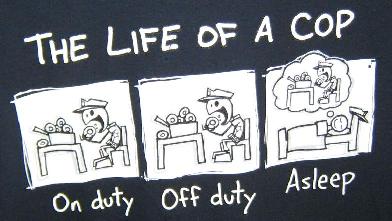
| Given the legendary connection between cops and donut shops
as documented in thousands of news articles, one would think
that these donut shops would be bastions of safety and security.
Sadly, in Framingham, all the Dunkin Donuts shops have been robbed
in the last couple years.
The police department shift times are:
If you want to commit a crime in Framingham, the best time is about 8:25 AM on a weekday. The cops will have settled down with their cup of coffee and donuts and will not be bothered. |
| Police constantly whine about how dangerous their jobs are. |
|---|
| The police constantly like to tell us how dangerous their jobs are.
Unfortunately, they have no information to back that statement up.
Here's a
listing of dangerous jobs/occupations
according to the
Bureau of Labor Statistics (BLS)
.
The most dangerous work the police do is detail work. If they do not pay attention (as in talk on their cellphone , they may get hit by a car. Of course, they fight each year to maintain their monopoly on this detail work. If injured while doing detail work, it should be called self-inflicted. Police jobs are very safe in relationship to many other jobs. We never see other occupations waste so much effort fluffing their feathers telling us how important they are to our well-being and civilization in general. |

| Police Technophobia |
|---|
| Let me see if I understand this correctly. Each year, we shell
out $550,000 just for the Quinn Bill
to educate the Framingham police so that they can get paid more,
and they then ask us for even more money to learn how to use computers.
More proof of greed and small mindedness . This is the first case I ever heard of a group filing a work grievance to town meeting over the use of computers. I guess that some are still submitting reports chiselled out on stone tablets, while others have started using papyrus. |
| Police Technophobia ` | Friday, June 27, 2008 | |
|---|---|---|
| Dan McDonald 508-626-4416 | Metrowest Daily News | |
|
In other business, Town Meeting narrowly defeated a measure that would have settled a labor dispute between the town and the Framingham Police Officers Union by a vote of 54 in favor to 64 opposed.
Prompting the dispute was a Police Department mandate requiring all police reports be filed electronically rather than with a pen and paper. At the time of the mandate, 80 percent of the officers were already filing reports electronically. In response, the union filed an unfair labor practice charge with the state's Division of Labor and a grievance with the town, according to the background materials for the warrant article. The grievance resulted in a demand for arbitration by the union. In its demand, the union alleges the Police Department violated the management rights featured in a collective bargaining agreement. If Town Meeting had appropriated the $41,000 line item, the two legal matters would have been resolved. "This would resolve two pending lawsuits in the town....that's something I support," said Town Counsel Chris Petrini before the vote . Now, the matter may go back to mediation. The measure did not sit well with Town Meeting member Rebecca Connelly . "The Police Department came before Town Meeting with a capital budget to ask us to fund laptops for their cruisers and now that we've provided them they're suing us because we're making them use them?" asked Conley. "Am I missing something here?" Town Meeting member Steve Orr said he was "a little disturbed," by the union's attempt to leverage more money for technology stipends. "It seems to me if there are people out there who are not willing to learn the incredibly difficult task of operating a laptop it seems like maybe they're not really interested in being a part of the police force in the first place," said Orr. | ||
|
Just a thought here.
Some police officers may not know the difference between Obiwankanobe and OBD-II. | ||
| Militarization of the Police
|
|---|
|
Bullies and those with various inferiority complexes have long been
attracted to police, or other kinds of governmental work; but today, it
seems that cruelty - as a personality trait - is a requirement for police work.
Exacerbating the growing specter of police inhumanity has been the militarization of practically every one of the 17,000 police organizations in the country; it's a very troubling development that has gotten worse yearly, since the assassination of President Kennedy.


To have civilian police departments now using heavy military equipment, automatic weapons, and the tactics, training, and even uniforms of the military, means but one thing: our governmental establishments are setting themselves against us -- the people. SWAT (Special Weapons and Tactics) teams were virtually unknown in the '50s and early '60s; but today, SWAT teams have become so prevalent, they're even used in routine warrant service in drug cases, and other nonviolent crimes, in spite of the fact, that para-military actions often trigger violence instead of defusing it. |

|
|---|
|
The transformation of a civilian into a police officer is called
"turning a silk purse into a sow's ear". You are endowed with the
powers loaned to you by the state and you may now become corrupted by
power, the only drug not controlled by the FDA.
The police process called civilianization is called "turning a sow's ear into a silk purse". You are stripped of the state powers that were loaned to you and you can now better understand reality. |
| Enforcing Small Fish Laws |
|---|
|
Inescapable proof that if you should ever try fishing in a police
officer's stream of consciousness, you would be destined to catch
many of these undersized, minute, dwarf minnows.
It was a good bust. Paul Shastany must be so proud. The police department will go to great lengths to enforce some obscure fish laws but make no effort whatsover to enforce immigration laws.


|



| Small fish leads to big problem ` | Wednesday, June 25, 2008 |
|---|---|
| Gabriel Leiner | Metrowest Daily News |
|
FRAMINGHAM -- Police said they caught two men Monday who were angling for a fish that was too small to keep.
Geraldo Jacob, 39, of 1630 Worcester Road, Apt. C421, Framingham, was arrested on charges of assault and battery of a public employee, disorderly conduct and resisting arrest, said police spokesman Lt. Paul Shastany. Geraldo Jacob and another Framingham man, Marcio Jacob, also are expected to be charged later by the state Environmental Police with possession of an undersized striped bass, a Division of Marine Fisheries dispatcher said. The arrest was made about 7:30 p.m. Monday after officers Tim O'Toole and Jeff DeRosa and Sgt. Richard Pomales reported seeing Geraldo Jacob carrying a small striped bass in the parking lot next to his apartment building. The Massachusetts Division of Marine Fisheries says that anglers can only keep a striper if it is more than 28 inches long. Shastany said the officers, in plain clothes but wearing their badges openly, approached Geraldo Jacob because they thought the bass looked to be under 28 inches. As the officers approached, Geraldo Jacob threw the bass in his trunk and shut the lid. The officers started writing down his license plate number, when Geraldo Jacob grabbed the paper and "got into a boxing stance," said Shastany. Shastany said Geraldo Jacob hit DeRosa and then 10 other men - one holding a large knife - rushed toward the officers. DeRosa drew his gun and yelled "Police!" to disperse the crowd. DeRosa and the two other officers then struggled with Geraldo Jacob before they made the arrest, Shastany said. After Geraldo Jacob was booked at the station, officers contacted Massachusetts Environmental Police Officer John Callan, who seized six fishing rods from Geraldo Jacob's car, Shastany said. Shastany said police were unsure when the state will file charges against the Jacobs for possession of the undersized bass. |
|
| Getting a grip on reality? | Thursday, October 31, 2002 |
|---|---|
| Tom Moroney | Metrowest Daily News |
| Where have you gone, Mr. Claw? If you think that's a silly
sentence, wait until you see the punch line.
Framingham police two weeks ago paid a visit to Bickford's Family Restaurant on Rte. 30 and ordered the place to shut down its "claw" toy-dispensing vending machine on the grounds that it is illegal. Some call it a crane machine. Either way, it's the glass-encased trinket holder that offers the chance to drop in coins and, using the claw inside, go fishing for a toy - from goblins at Halloween to little Santas at Christmas. This novelty device is as American as pancakes and syrup, and probably just as old. Who knew it was unlawful? "The claw machine is a game of chance," said police Lt. Wayne McCarthy, the town's licensing office and deliverer of the bad news to Bickford's. And any game of chance, according to McCarthy, is illegal under Massachusetts law, Chapter 271, section 5a. Of course, I pointed out, the Lottery is a game of chance and that's not illegal, but we all know why. The state gets big bucks for all the chances we take on that. Interestingly, towns and cities get money from the claw machines too. You see, not every municipality enforces the claw law, banning them. Marlborough, according to my sources, has more than several. And local licenses can range from $75 to $150 a year. The machine at Bickford's in Framingham was licensed, which only added to the shock of the restaurant manager, who did not want his name used. "Yes, I was very surprised when it happened," he said. "It had been here for years. I really didn't see the point. "It's kind of strange," he added. Strange maybe. But necessary, according to McCarthy, who, as license officer, oversees the registration of everything from guns to sex offenders to claws. (Can we all agree sex offenders are probably more dangerous than vending machines stocked with small pillows featuring Casper the Ghost?) So why the crackdown? The reason was Wal-Mart, McCarthy said. The giant chain, which recently opened a new store on Rte. 9 in Framingham, applied for permission to install a kiddie ride and a claw machine. McCarthy, in reviewing the license, vetoed the claw. "Wal-Mart had no problem with the decision," he said. But McCarthy said he began thinking about the other claw machines in town. "If I was going to say no to Wal-Mart, it wasn't fair to let the others go," he said. So he made his rounds on a Saturday two weeks ago, dropping by Bickford's, Papa Gino's and the Tin Alley Grill, ordering them to unplug the machines and have them removed. To be fair, McCarthy is a good cop and a straight-shooter. And there is some historical background that gives him reason to be so attentive here. Back in the '80s, police removed seven or eight games of chance from Fun and Games, the Rte. 9 arcade. A big court battle ensued, and since then, the town has tried to be diligent on these matters, he said. So I decided to do some diligence of my own. I dropped by the Tin Alley Grill, one of the places he visited, and saw that the restaurant still had its machine going. It is dubbed, "Treasure Chest," and, for $2 a play, will provide the claw operator with a toy every time. A manager at Tin Alley said the guarantee of a toy every time meant the machine did not represent a game of chance and therefore was legal. Not so, said McCarthy when I told him of my observations. "I told Tin Alley to remove it," he said. "I may have to go back and visit them." And then he added: "How does it feel to be a police informant?" What a comedian. Even if it gives a toy each time, McCarthy continued, the game still relies more on chance than skill, thus violating the law. "But who determines that line between chance and skill?" said Rob Slade, who owns the claw machine that was ordered removed from Bickford's. Slade, whose company, Adventure Vending Co., is based in Southborough, said he has 150 claw machines operating in four New England states. "And Framingham is the only town where I've had any trouble," he said. "Why are they going after me? There's really no harm here." In fact, Slade said, it may not even be a violation of law. He said a judge in Los Angeles in 1998 ordered a claw machine similar to Slade's be tested to see if success was based on chance or skill. The independent tester, he said, concluded that the claw machine is indeed a game of skill. "You get better at it the more you play," he said. I'm not sure I'd want to find out. Still, the machines do seem like a rather innocent enterprise. "What would you say to the teary-eyed boy who'll wonder, 'Where's Mr. Claw?' " I asked McCarthy. "I'd say, 'Son, put your money in a safe place,' " he replied. Now, why didn't I think of that when my kids were clamoring for coins and a shot at the claw? |
|

|
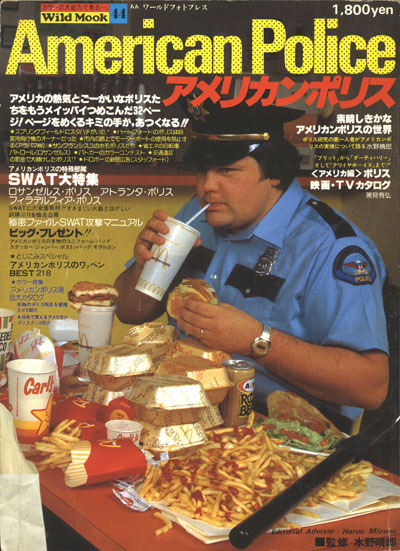
| Owen Babineau's Favorite Magazine |
|---|

|
| How the Japanese see American police officers |
|
Send comments to:
 hjw2001@gmail.com
|

|